
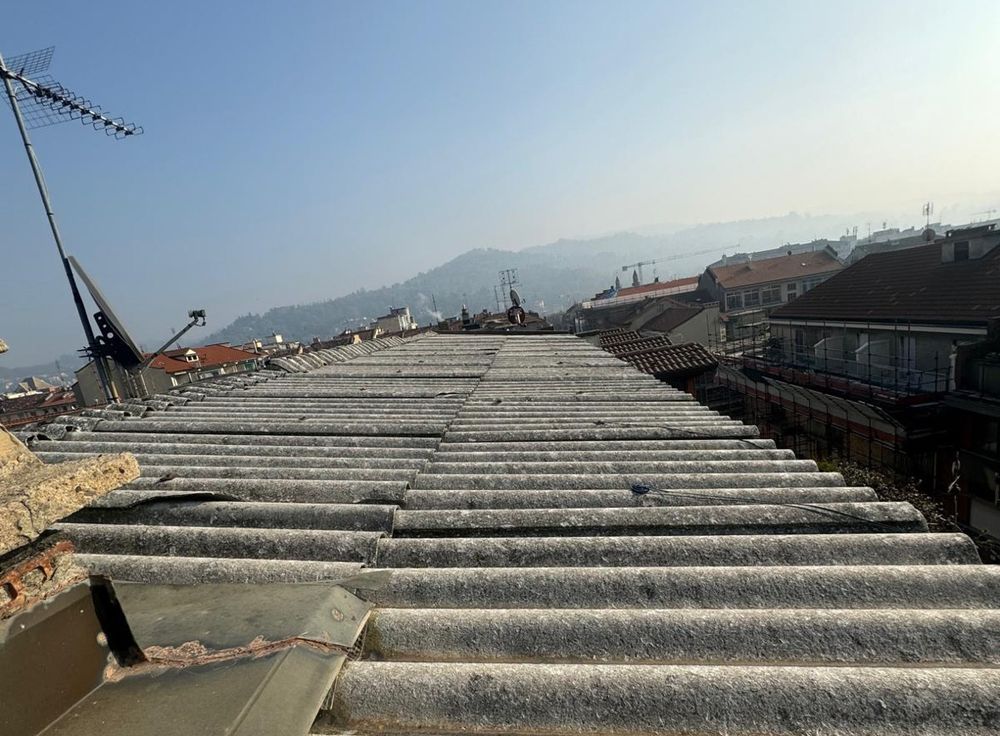
The grey corrugated "eternit" sheets are asbestos cement: as long as they are intact they release no fibres, but over the years they flake, and at that point they must be removed by a licensed company, following a precise procedure. We have been doing it for years on roofs, canopies and industrial buildings: here is how it works.
How to recognise it
- Grey corrugated or flat sheets, often with moss and lichen, laid before 1992 (the year of the ban in Italy).
- Flues, water tanks, cladding panels of industrial buildings.
- Doubts are settled by a laboratory sample: it costs little and gives certainty.
When intervention is mandatory
The law does not require removal of an intact element, but it requires the owner to assess its condition and act if it is deteriorated (flaking, breaks, dust). Removing it when the roof is redone is in any case the most sensible choice: it is done once, with the scaffolding already up.
The procedure
- Work plan submitted to the local health authority (ASL) by the licensed company (registered in the environmental operators' register, category 10). Clearance is awaited: generally 30 days.
- Encapsulation of the sheets with a product that binds the fibres, before touching them.
- Manual removal, without breaking the sheets, by trained operators with protective equipment; the area is cordoned off.
- Packaging in labelled sheeting and transport to an authorised landfill with the waste form.
- Disposal certificate: the document that stays with you and is also needed when the property is sold.
What replaces the asbestos cement
Almost always insulated corrugated sheet metal (sandwich panel): light, fast, insulated, and it sits on the existing structure without reinforcement. On houses, clay tiles or flat tiles too. The comparison of roof coverings is in our guides; an example of removal with a new sheet-metal roof is our roof in Via Michelangelo Buonarroti.
What the owner must do
- Use a licensed company and ask for the disposal certificate: without it the job is not compliant.
- Keep the documents (work plan, waste form, certificate) with the house papers.
- Never try to remove or break the sheets yourself: it is dangerous and forbidden.
Timing and incentives
Between the health-authority clearance and the works, allow about two months; the removal itself takes a few days. The removal qualifies for the renovation bonus and, for businesses, regional and INAIL grants open periodically: we let you know when they do.
Would you like an opinion on your case?
The site visit is free and the quote is written and itemised.
More guides
 Windows
uPVC or aluminium windows? An honest comparison
Insulation, lifespan, maintenance, looks and cost: how to choose the right windows for a home in Turin, with timber-aluminium as a third option.
6 min read Roofs
Tiles or sheet metal? Which roof to choose
Clay tiles, Ardogres tiles and corrugated sheet metal compared on lifespan, weight, cost, laying and maintenance. Tap a criterion to see which one wins.
4 min read Electrical systems
BTicino and Vimar switch plates: which to choose (and how much the price changes)
Living Now, Living Light, Matix, Axolute, Plana, Arké, Eikon, Idea: the series we install most often, the real differences and the price bands.
7 min read